

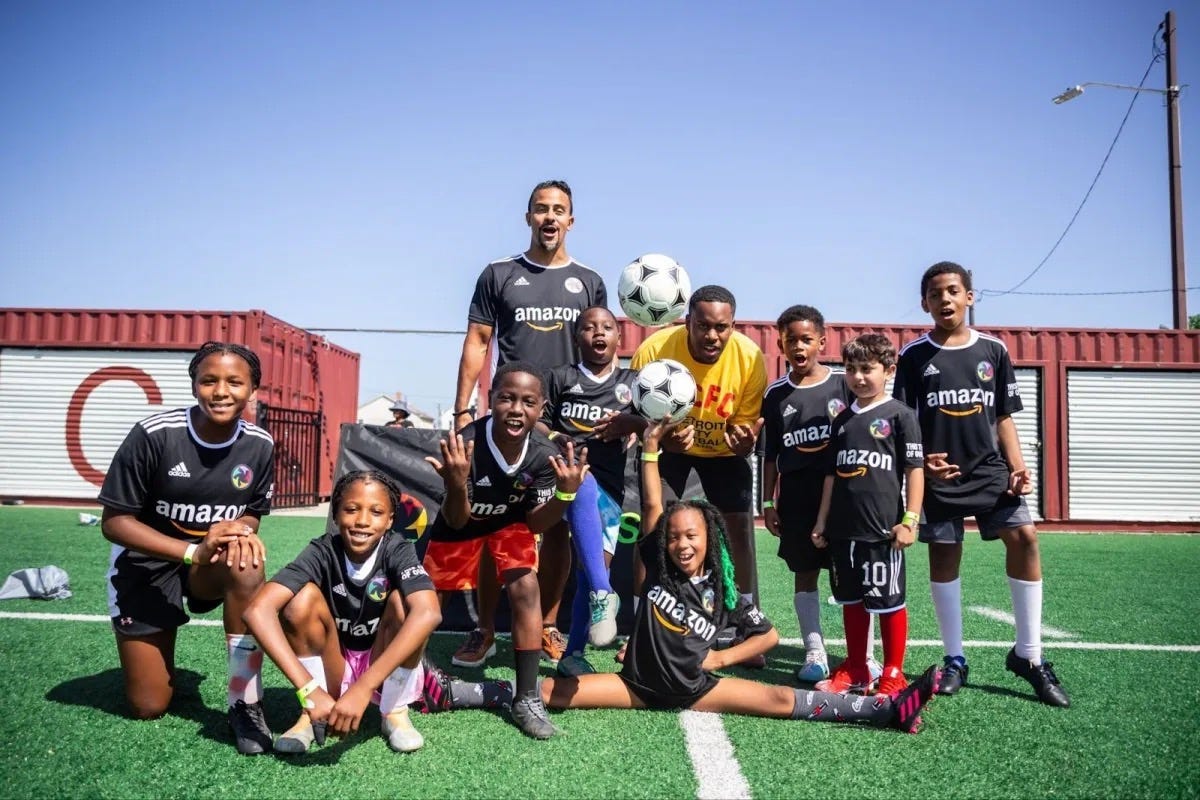
The photograph that keeps returning to me is a simple one: a group of Black teenagers at a soccer academy in Atlanta, 2019, standing apart from their white and Latino teammates during a team dinner. Not by choice, exactly—but by the accumulated weight of a sport that has never quite made room for them. The caption read: “Building the future of American soccer.” But whose future was being built?
This image haunts me because it captures something the soccer establishment has spent thirty years failing to articulate: diversity in a sport is not simply a matter of access or recruitment. It is fundamentally a question of cultural belonging, of whether a community sees itself not just playing a game, but owning it.
American soccer has a diversity problem. But more precisely, it has an identity problem—one that even the most earnest diversity initiatives cannot solve, because the problem does not originate in soccer. It originates in the absence of soccer from African American cultural life.
How Soccer Cultures Are Actually Built
The fundamental problem has nothing to do with Black Americans’ capacity for soccer or their interest in sport. It has to do with how soccer cultures are actually constructed in the world, and why America’s model is uniquely hostile to grassroots participation.
Go to any city in Europe, Latin America, Africa, or Asia, and you will find the same pattern: soccer culture is born in the streets. Children play in parks, in alleyways, on any patch of open ground. The game requires nothing—a ball, space, imagination. From this street culture emerge the talented players who eventually enter clubs. The clubs build upon an already-existing cultural foundation. Soccer is already owned by the community before any institution touches it.
This is how the game grew in England, Brazil, Argentina, Nigeria, Mexico. It is how it grew in the neighborhoods where immigrant communities settled in America—where Dominican kids played in the Bronx, where Mexican kids played in Los Angeles, where it became woven into community identity precisely because it required minimal resources and could be played anywhere.
But in Black America, this street culture of soccer simply does not exist. And it does not exist for a specific reason: American youth soccer was designed, from its inception in the 1990s, to bypass the streets entirely.
The infrastructure of American soccer—the club system, the pay-to-play model, the travel teams, the expensive academies—was built deliberately to operate outside of grassroots culture. Youth soccer exploded in the suburbs at the precise moment when American families had leisure time and disposable income. It became a vehicle for parental investment in childhood development, a structured alternative to unorganized street play. The entire ecosystem presupposed affluence: the ability to pay club fees, to drive to distant fields on weekends, to invest thousands of dollars annually in coaching and development.
For Black communities in America, this model meant something explicit: soccer was not a game you could teach your child in the neighborhood. It was not something that emerged organically from street culture. It was something you had to purchase from an institution. And if you did not have the resources, it simply did not exist in your world.
Basketball and football found their way into Black America because they required nothing but a ball and a hoop or a field. They were grafted onto existing street culture, playground culture, neighborhood culture. The excellence emerged from millions of kids playing freely, and from that vast pool of street players, the talented ones were identified and developed further.
Soccer was different. Soccer required institutional mediation. It required payment. It required parents who understood the value proposition well enough to invest in it. It required cultural knowledge that Black Americans simply did not have, because the game had never been present in their neighborhoods, never been part of their cultural vocabulary.
The result is that while millions of Black kids grew up with basketball in their veins—shooting on courts in every neighborhood, learning the game from older siblings and cousins, developing a relationship with the sport that predated any formal coaching—virtually no Black American kids grew up with soccer in the same way. There was no street game. There was no neighborhood tradition. There was no older generation that played and could teach the younger generation.
This is not a problem that diversity programs can solve. This is a problem that only a street culture can solve.
Why Even Good Programs Cannot Solve This
This is where organizations like the Philadelphia Union’s SWAG program enter the picture. SWAG represents a genuine attempt to do something different: to build something closer to what street soccer looks like, accessible and culturally connected, rooted in neighborhood identity rather than in the pay-to-play apparatus.
And yet, even the most well-intentioned programs operating within the American club system are fundamentally constrained by that system. They are trying to create street culture from within institutions. They are trying to replicate something that can only be authentically born outside of institutions.
Compare SWAG to a grassroots club like Dynamo in London. Dynamo operates from within a street culture that already exists. Children in those neighborhoods learn soccer the way children everywhere else in the world learn it: by playing it freely, by seeing older kids play it, by having it woven into the fabric of community life. When Dynamo identifies talent, they are drawing from a vast pool of kids who have already internalized the game, who already see it as part of their identity.
SWAG, by contrast, is operating in a vacuum. It is trying to create soccer culture where none exists. It is competing against the reality that in most Black American neighborhoods, there simply is no street soccer. There are no kids kicking a ball around after school because soccer has never been part of that community’s identity. Even if SWAG reaches hundreds or thousands of kids, it is a program. It is an intervention. It is something that requires institutional belief and parental commitment to participate in.
Street culture requires none of that. It simply requires space and a ball.
The United States is the only major soccer-playing country where this fundamental inversion exists: where the game is born in clubs and attempts to extend downward to the streets, rather than being born in the streets and extending upward to clubs. Everywhere else, the cultural foundation precedes the institutional structure. In America, the institution precedes the culture.
For Black America in particular, this inversion has been total. There is no street soccer culture. There is only the club apparatus, which by its very nature is selective, expensive, and available only to those who can afford to participate.
Even SWAG, for all its sophistication and genuine commitment, cannot fully escape this constraint. It can remove some barriers. It can create pathways. It can build narratives about who belongs in soccer. But it cannot do what only a street culture can do: make soccer something that is simply there, available to every child, requiring nothing but the desire to play.
This is where mainstream American soccer’s current approach begins to reveal its fundamental limitations. Since the 2010s, the U.S. Soccer Federation and the professional leagues have launched numerous initiatives aimed at increasing Black participation: diversity scholarships, community development programs, grassroots clinics in underserved neighborhoods. These efforts are not cynical; many are genuine.
But they mistake the problem for one of access. They assume that if you build the pathway, people will come. That if you provide coaching and fields and opportunity, Black families will suddenly embrace a sport that carries no cultural weight in their communities.
This misses the essential truth: you cannot sell someone a sporting identity that does not connect to their existing cultural narrative. A Black family in South Los Angeles does not choose to invest $5,000 a year in youth club soccer because a well-meaning youth development officer knocked on their door. They choose basketball or football because those sports come pre-loaded with meaning, with role models who look like them, with a sense that this is a viable path, that the sacrifice might yield something.
Soccer, in the African American context, remains something foreign. It remains what white kids and immigrant kids do. And no amount of diversity programming can rewire that cultural inheritance overnight.
The Problem That Soccer Cannot Solve
Here is the uncomfortable truth that the soccer industry must grapple with: they cannot solve this problem alone. The deficit is not really theirs to fix.
If African American participation in soccer is low, the root cause is not that U.S. Soccer lacks diversity programs. It is that for generations, Black America invested its athletic imagination, its capital, and its cultural narrative in other sports. Those decisions were rational, given the historical moment. Football and basketball offered clearer pathways to professional success, better representation in media, stronger cultural integration. They became part of how Black identity itself was constructed in America.
For soccer to build a genuine African American constituency, it would need to alter something far more profound than the composition of academy rosters or the marketing campaigns of the MLS. It would need to become embedded in the fabric of African American community life in the way that basketball has become embedded at the playground, the way that football has become embedded in the mythology of uplift and aspiration.
This cannot be mandated from the federation office. It cannot be achieved through recruitment drives or diversity reports. It can only happen if African American athletes, coaches, journalists, and community leaders choose to invest in the sport themselves—to build a culture around it, to create narratives, to develop institutions and traditions that make soccer something owned by that community rather than something offered to it.
Some of this is beginning to happen organically. Black youth soccer coaches are building programs. Black journalists are covering the sport with sophistication and depth. Black players like Sergiño Dest and others are emerging in visible roles. But these developments are still fragile, still contingent, still fighting against a century of sporting tradition that points in other directions.
The Conversation That Exists Without Them
If you spend any time on Instagram or YouTube, you will find an endless stream of content about American soccer’s problems. Videos dissecting why the U.S. can’t compete internationally. Podcasts analyzing the failures of youth development. TikTok creators breaking down tactical deficiencies. Entire channels devoted to examining how other countries develop talent so much more effectively.
The conversation about what’s wrong with American soccer is ubiquitous, visible, and animated. Soccer enthusiasts have built an entire media ecosystem around diagnosing and debating the sport’s shortcomings.
And yet, Black Americans are almost entirely absent from this conversation. Not as subjects of critique, but as participants in the debate itself. The voices analyzing American soccer’s problems, the creators building audiences around soccer discourse, the analysts and commentators and educators engaging with the sport’s future—this ecosystem is, with rare exceptions, almost entirely not Black.
This is not an accident. It is not a coincidence. It is a reflection of the fundamental absence we have been discussing.
In countries where soccer is embedded in street culture, the conversation about the sport happens everywhere—in barbershops, on street corners, in family conversations. It is woven into the cultural fabric because the sport is woven into the cultural fabric. Everyone has opinions about soccer because everyone has grown up with soccer.
In Black America, there is no such ambient conversation. There is no baseline cultural knowledge from which to build commentary and analysis. The absence of street culture means the absence of a natural constituency of commentators, analysts, and enthusiasts who might drive the conversation about the sport’s direction.
What exists instead is a fragmented ecosystem: white suburban soccer enthusiasts debating technical matters, immigrant communities with their own soccer cultures operating in parallel, and a broad Black American population largely untouched by and uninterested in any of it. The conversation about American soccer’s problems happens in a bubble, discussed by people who already care about soccer, for an audience that already cares about soccer.
The fact that Black Americans are not part of that conversation—not even as critics—is perhaps the most damning evidence of all. If Black communities saw soccer as part of their world, they would have something to say about it. They would be in the YouTube comments. They would be creating content. They would be part of the discourse.
Instead, silence. Not because Black Americans lack analytical capacity or interest in sports. But because soccer simply is not yet part of their cultural conversation.
The Difference Between Representation and Roots
What soccer has learned—painfully and incompletely—is the difference between representation and roots. You can have Black faces in your elite academies without having a Black soccer culture. You can increase Black participation at the youth level without developing the infrastructure, narrative, and institutional commitment that sustains a sporting identity across generations.
True diversity in sport is not a matter of demographic engineering. It is what happens when a community collectively decides that a sport is worth their time, their money, and their emotional investment. It is what happens when a grandmother teaches her granddaughter how to play, when a coach is someone from the neighborhood, when ESPN coverage feels like it is speaking to you, when the pathway to success feels real and visible and possible.
This is what exists naturally in football and basketball for Black America. And this is what is almost entirely absent from soccer.
What We Have Never Seen
But here is what haunts soccer’s current moment with a different kind of urgency: we do not actually know what American soccer looks like when Black Americans embrace it in volume.
Take a trip to South London—to the academies and clubs where young players train. What you see there is instructive. Black children are everywhere. Not as tokens in diversity initiatives. Not as the occasional standout. But as part of the fabric, as the constituency, as the baseline of what competitive youth soccer looks like. And the sport does not look smaller for their presence. It looks fundamentally different.
The athletic profile changes. The speed changes. The explosiveness and verticality that has always been available to American soccer suddenly becomes visible at scale. You see what happens when a fully genetically diverse population, trained with the same intensity and resources, competes at the highest developmental levels. You see athleticism that has been systematically absent from American soccer’s visible pipeline.
The creativity changes too. When you have volume participation from a community with deep roots in improvisation, in rhythm-based athleticism, in the kind of street-level play that characterizes how African Americans have historically engaged with basketball and football—you get something different. You get a style that reflects that cultural inheritance, that linguistic inheritance, that way of moving and creating.
This is not a matter of racial determinism or essentialist claims about athletic ability. It is simply an observation of what happens in places where participation is not limited by cultural gatekeeping or invisible barriers. You see players. You see diversity of style. You see the sport being developed not from a narrow demographic slice but from a genuine cross-section of the population.
American soccer has built itself around a particular template of what a soccer player looks like—shaped by the particular communities that embraced the sport in the 1990s and 2000s. What would happen if that template were disrupted by the arrival of millions of Black American youth soccer players, trained from age six, competing at the highest levels?
No one knows, because it has never happened at scale.
The Untapped Revolution
This is not a diversity problem in the conventional sense. This is a potential revolution that soccer is too small to see coming.
If African American communities collectively embraced soccer the way they have embraced basketball and football, the sport would not simply become more “diverse.” It would be transformed. The technical and tactical evolution would be undeniable. The player development pipeline would suddenly look different. The domestic league would attract players who would have gone to the NFL or NBA. The national team would be operating with a completely different pool of talent.
American soccer could become a genuinely world-class project—not through better coaching or new academies, but simply through access to the full scope of American athletic talent.
But this requires something that cannot be mandated from the federation offices. It requires a community decision. It requires African American families, coaches, athletes, and institutions to see soccer not as a sport someone is trying to sell them, but as something worth building together. It requires parents to believe that this investment might yield something. It requires older players and mentors to demonstrate that the pathway is real. It requires narrative, representation, and most fundamentally, it requires volume.
The soccer establishment seems to believe that if they simply keep the door open, keep the programs welcoming, keep the messages inclusive, eventually African American communities will walk through. But communities do not work that way. Sports do not work that way. Culture does not work that way.
What is required is not more programs from U.S. Soccer. What is required is for African American communities to decide, for themselves and on their own terms, whether soccer is worth their investment. That decision cannot be gifted. It cannot be recruited. It must be chosen.
When it is—and if it is—American soccer will look like a different sport. Not incrementally better. Different. The players will move differently. The game will sound different. The tactical imagination will be expanded by sensibilities that have never properly been represented at scale in the sport.
American soccer is waiting for a transformation it does not yet have the language to name. And it is waiting in the hands of a community that has not yet decided whether to give it.