

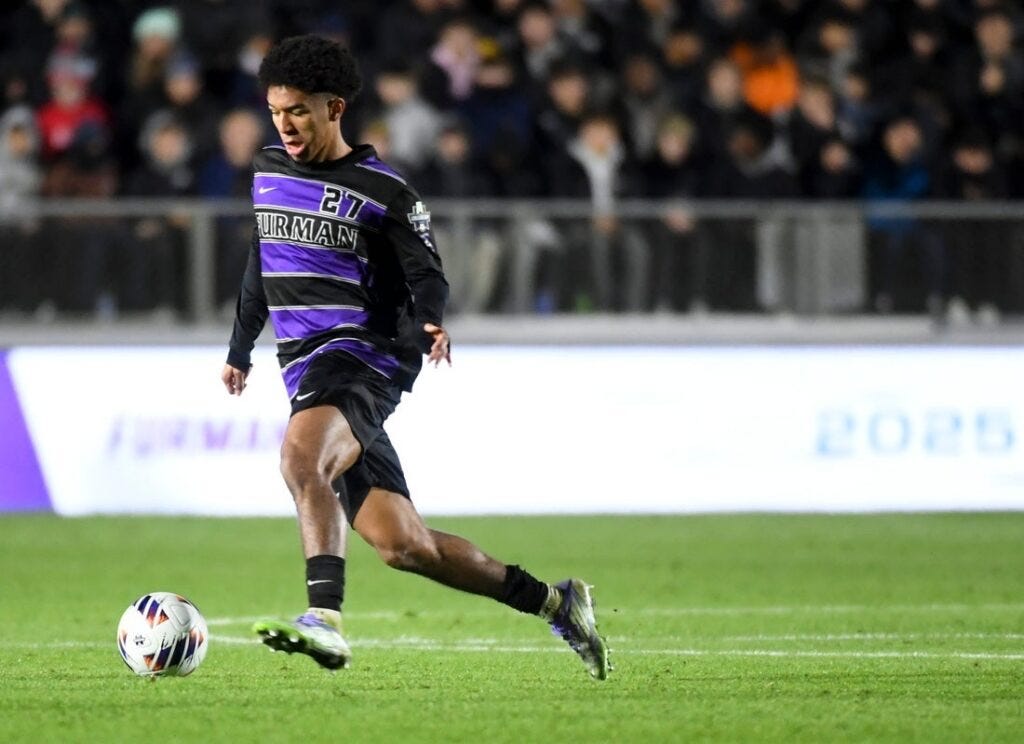
On August 27, 2026, Luke Munson took the field for Furman University against Duke.
He was 19 years old.
A talented defender who had already progressed through the academies of FC Dallas and Charlotte FC, Munson had every reason to believe his soccer journey was still unfolding. He had competed in MLS NEXT Pro, established himself as a collegiate starter, and helped Furman reach its first NCAA College Cup.
Like thousands of young athletes, he had spent much of his childhood pursuing a dream.
Then everything changed.
During that game against Duke, Munson suffered a traumatic leg injury. Complications followed, requiring additional surgery. Ultimately, his lower leg was amputated.
His playing career was over.
In a heartbreaking message reflecting on 13 years of soccer, Munson addressed the child he once was:
“Finally, to the little kid that had dreams of going pro 13 years ago I’m sorry our dream had to end.”
Those words should resonate far beyond the soccer community.
Because this is not simply a story about an injury.
It is a story about risk, unrealized potential, and how quickly an athlete’s future can change.
The Black Swan Nobody Plans For
In risk management, the term black swan describes an event that is extraordinarily difficult to predict, carries significant consequences, and is often rationalized after it occurs.
Catastrophic athletic injuries are not inherently unpredictable as a category. We know they happen. We have decades of medical research, actuarial data, and insurance experience demonstrating their consequences.
But for the individual athlete, the specific moment can feel unimaginable.
There is no warning that the next tackle, collision, landing, or seemingly routine play could be the last of a career.
One moment, an athlete is building toward a professional contract.
The next, the conversation shifts to surgeries, rehabilitation, long-term care, and life beyond competition.
That is the fundamental challenge of athletic risk.
We spend enormous resources developing athletic potential, yet too often treat protecting that potential as an afterthought.
Athletic Potential Has Economic Value
The commercialization of college athletics has fundamentally changed how we should evaluate risk.
An athlete is no longer simply a participant in an athletic program.
Increasingly, athletes operate as economic enterprises.
Their future earning potential may include professional contracts, name, image and likeness (NIL) opportunities, endorsements, appearances, intellectual property, and entrepreneurial ventures.
For an emerging athlete, those opportunities may be years away. But their potential economic value is being built long before the first significant paycheck.
Consider the investment that goes into developing a high-level soccer player.
Years of academy training. Travel. Coaching. Family sacrifices. Exposure events. Competitive development. Recruitment.
All of it is directed toward creating future opportunities.
Yet the asset being developed—the athlete’s ability to perform—is inherently vulnerable.
A catastrophic injury can eliminate or materially diminish that earning potential overnight.
That raises an important question:
If an athlete’s future earning capacity is valuable enough to invest in, why isn’t protecting that capacity equally central to the development process?
Medical Insurance Is Not the Same as Career Protection
The NCAA has established meaningful insurance protections, including its Catastrophic Injury Insurance Program, which provides excess benefits once covered medical expenses exceed a $90,000 deductible.
The NCAA also maintains a post-eligibility insurance program for eligible athletic injuries.
These protections matter.
But medical expense coverage and financial protection against lost athletic opportunity address different risks.
Medical insurance can help address treatment costs, subject to policy terms.
It does not automatically replace the professional contract an athlete may never sign.
It does not necessarily compensate an athlete for future endorsement opportunities that disappear.
Nor does it automatically provide a comprehensive financial transition plan when an athletic career ends prematurely.
This distinction is critical.
An athlete may have access to substantial medical benefits while still facing significant uncertainty about long-term earning capacity, career transition, and financial stability.
Protecting the athlete’s health and protecting the athlete’s economic future are related, but they are not the same undertaking.
Athlete Protect: Building Protection Around the Athlete
My professional career has spanned two industries that increasingly intersect: sports and global risk management.
I’ve worked in professional football scouting and operations, athlete-related risk placements, and complex commercial insurance.
Across those experiences, one observation continues to shape my thinking:
Athletes and the organizations supporting them need a more comprehensive approach to risk.
That thinking informs Athlete Protect—a coordinated suite of risk-management solutions organized around three pillars.
Athlete Performance
This is perhaps the most immediate connection to Munson’s story.
Athlete Performance focuses on protecting athletic earning capacity and addressing the financial consequences of serious injury.
Depending on eligibility, underwriting, policy wording, and insurable interests, solutions may include:
Permanent Total Disability (PTD) insurance
Loss of Value (LOV) protection
Accidental death and dismemberment coverage
Accident and supplemental medical benefits
Contractual and income-related risk solutions
These are distinct products with different triggers, limitations, and eligibility criteria. Not every athlete qualifies for every form of coverage, and coverage is never automatic.
The objective is to assess the athlete’s financial exposure before a catastrophic event occurs.
Importantly, coverage should not be reserved exclusively for athletes who have already signed lucrative professional contracts.
The conversation should begin earlier, when the athlete’s projected career and economic opportunity are still developing.
Athlete Enterprise
Today’s athletes are building businesses and commercial identities alongside their sporting careers.
NIL arrangements, endorsement agreements, media ventures, personal brands, and family financial interests can create substantial opportunities—and new exposures.
Athlete Enterprise focuses on protecting those broader commercial interests through appropriate business insurance, cyber risk solutions, liability programs, and related advisory services.
An injury that ends competition does not necessarily end an athlete’s ability to build an enterprise.
In fact, an established brand or business may become an important part of the next chapter.
Athlete Defense
A catastrophic event can also create difficult legal, contractual, reputational, and organizational questions.
Athlete Defense addresses the legal, regulatory, and crisis-management risks surrounding athletes and their commercial activities.
Depending on the circumstances, this may involve access to appropriate legal resources, crisis response coordination, contractual risk assessment, and specialized insurance protection.
Athletes should not have to navigate complex risk issues without experienced professional support.
Together, these three pillars reflect a simple principle:
Protect the athlete’s ability to perform, the enterprise they are building, and the interests that may be exposed when something goes wrong.
The Responsibility Extends Beyond the Athlete
Munson’s situation also raises a broader institutional question.
What responsibility should universities, athletic departments, agents, advisors, and development organizations assume when helping young athletes pursue careers built around physical performance?
The discussion should not begin after a devastating injury.
Risk assessment should be integrated into athlete development.
That means understanding existing medical and catastrophic injury coverage, evaluating appropriate disability and accident solutions, documenting potential gaps, and establishing procedures for serious incidents.
It also means recognizing that the athlete’s needs may change as their career develops.
A highly recruited high school prospect, an established collegiate athlete, and a professional player entering a major contract face different financial exposures.
Their protection strategies should reflect those differences.
For athletic departments and sports organizations, athlete protection should be viewed as part of institutional risk management and duty of care, not merely an insurance purchase.
And for families and advisors, it should become a normal part of conversations about long-term athletic planning.
The Cost of Protection Versus the Cost of Being Unprotected
In commercial risk management, organizations routinely insure physical assets, business interruption exposures, executive liabilities, and anticipated revenue streams.
They do so because the financial consequences of an unexpected event can be greater than the cost of transferring selected risks.
Athletic careers warrant similar consideration.
The challenge is that young athletes often have limited financial resources, uncertain professional projections, and varying levels of access to insurance products.
That makes thoughtful structuring particularly important.
Institutions, sponsors, athlete representatives, and families should explore what protections are commercially available, legally permissible, financially practical, and appropriate for the athlete’s circumstances.
Not every risk can be insured.
Not every lost opportunity can be quantified.
And no insurance policy can replace the ability to play a sport you love.
But appropriate planning may help prevent a physical tragedy from becoming an equally devastating financial one.
A Career Can End. The Person’s Future Must Not.
There is something particularly heartbreaking about Munson’s message to his younger self.
He apologized for a dream that could no longer continue.
But he owes that younger version of himself no apology.
Thirteen years of dedication, sacrifice, competition, and achievement are not erased by a single catastrophic event.
And although his playing career has ended, his future remains full of possibilities that extend beyond soccer.
His story deserves compassion, privacy, and support—not speculation about his personal finances or existing insurance arrangements.
We do not know the details of his coverage, and it would be inappropriate to assume that he or his university failed to plan for this possibility.
But his experience should motivate a larger conversation about the financial architecture surrounding athletic development.
Because the risks are real.
And the consequences can be life-altering.
The black swan event does not wait until an athlete signs their first professional contract.
It does not wait until the NIL valuation rises.
It does not wait until a family can afford a comprehensive protection program.
It can arrive in the middle of an ordinary game.
At 19 years old.
With an entire career seemingly ahead.
That is why Athlete Protect exists as a risk-management framework.
Not because we can eliminate uncertainty.
But because we can identify exposures, evaluate solutions, and help athletes and sports organizations prepare for consequences that are too important to ignore.
We cannot always protect the dream from ending.
But we should do everything reasonably possible to protect the person—and their future—when it does.