

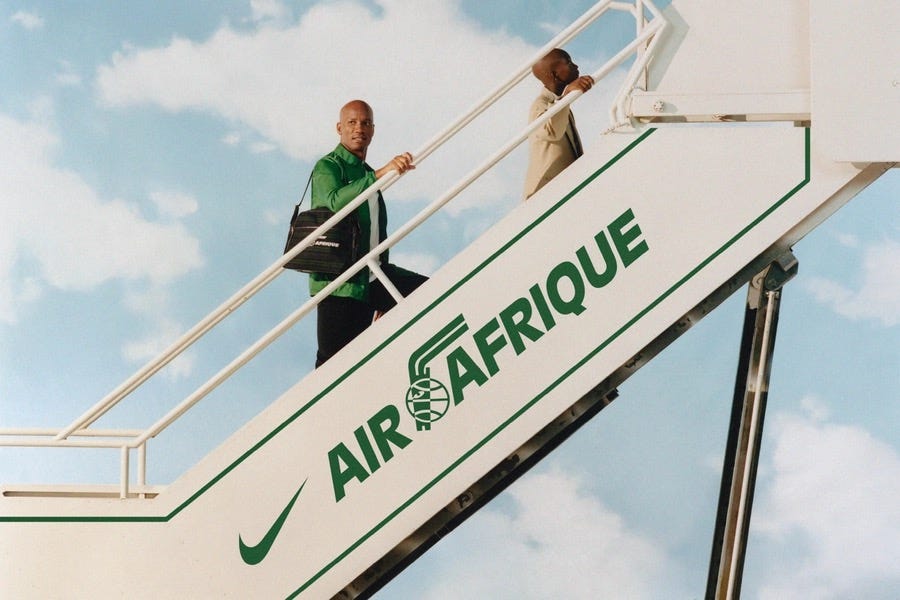
What makes Nike’s current posture toward Africa feel different isn’t volume or velocity. It’s familiarity. The brand isn’t studying the continent from a distance; it’s behaving as though it already understands the codes. That understanding comes through most clearly in two decisions that, taken together, feel quietly monumental: the Air Afrique collaboration and the elevation of Jay-Jay Okocha as a cultural authority rather than a nostalgic reference.
Air Afrique is not an obvious brand partner if the goal is simple commercial return. The airline no longer flies. Its value lives in memory—in the idea of Africa in motion, of continental confidence before globalization flattened ambition into extractive routes. By choosing that symbol, Nike situates itself inside a lineage rather than above it. The sneaker becomes secondary. What matters is the narrative: Africa as connective tissue between continents, between generations, between those who left and those who stayed.
Launching the product on the continent first was not a marketing flourish. It was a signal. For decades, Africa has watched its stories be validated elsewhere before being reflected back home. Nike reversed that flow. The implication is subtle but powerful: Africa doesn’t need external approval to be culturally central. It already is.
The Jay-Jay Okocha campaign deepens that signal. Okocha’s role is not symbolic; it is structural. Nike does not frame him as an “African great” in isolation. It places him in a lineage the brand knows well—the same lineage once occupied by Brazilian icons who defined football as art before it became industry. Ronaldinho, Ronaldo, Romário. Players whose value wasn’t discipline or conformity, but joy, flair, improvisation, and freedom.
By positioning Okocha in that same conceptual space, Nike is making a statement that African football has long deserved but rarely received: not just talent, not just athleticism, but authorship. Style. Philosophy. Cultural authority.
This matters because Brazilian football was never just celebrated—it was protected, marketed, and mythologized. Nike helped turn Brazilian expression into a global commercial language. Doing the same with African football represents a shift that goes beyond representation. It suggests Nike believes African creativity isn’t something to be filtered through European systems for validation. It can stand on its own terms, in its own voice.
That belief carries risk. African markets are fragmented. Infrastructure remains uneven. Political instability—both local and global—adds layers of uncertainty. At the same time Nike is investing culturally, U.S. policy has moved toward restriction, signaling skepticism about African mobility and access. The contrast is striking. Where politics sees borders and risk, Nike sees circulation and influence. Where governments limit movement, the brand invests in it.
This divergence underscores Nike’s long-term calculus. Influence doesn’t pause at customs. African culture already exists in London academies, Paris banlieues, American locker rooms, and global music charts. The diaspora continues to shape sport and style regardless of policy. Nike is aligning itself with that reality rather than resisting it.
There is also the risk of expectation. Elevating Africa in this way demands follow-through—distribution, pricing, access, and sustained presence. Symbolism without infrastructure erodes trust quickly. But Nike’s measured approach suggests awareness. This is not a land grab. It’s a foundation.
What feels most significant is how natural it all appears. Nike isn’t announcing Africa as the future. It’s behaving as if that conclusion has already been reached internally. The Air Afrique collaboration and the Okocha campaign aren’t experiments. They’re signals of recognition.
In the same way Nike once understood that Brazilian football was not peripheral but central to the global game, the brand now appears to see African sport the same way—not as potential, but as presence. Not as raw material, but as authorship.
History tends to reward the brands that recognize cultural gravity before it becomes consensus. Nike has done this before. The difference now is where it’s choosing to stand.